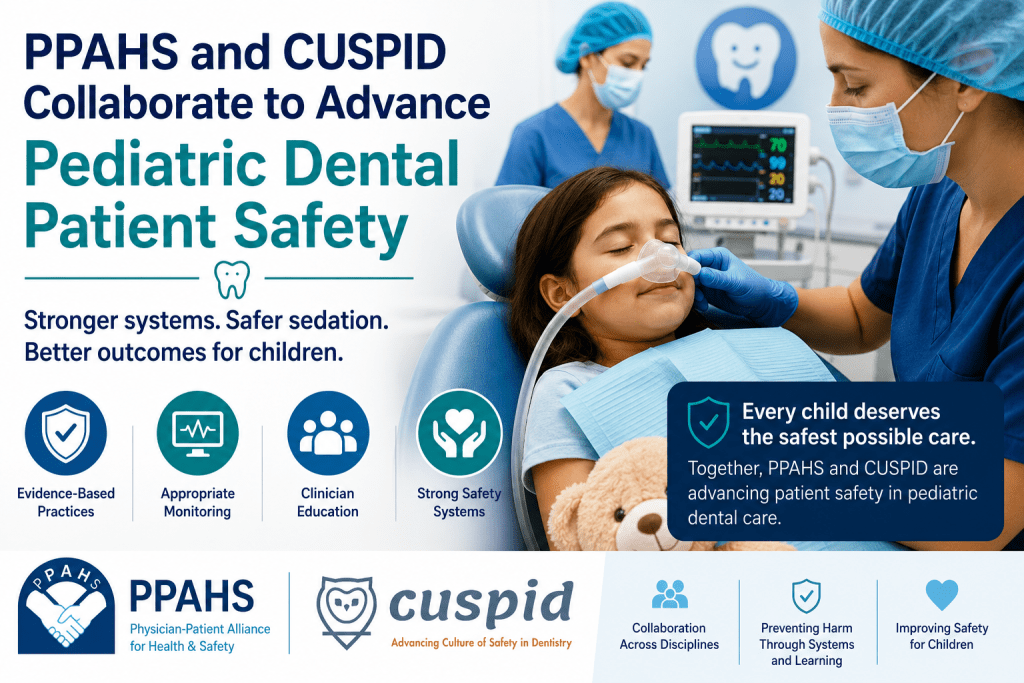
Safe dental care for children is an important patient safety priority requiring evidence-based practices, appropriate monitoring, clinician education, and strong safety systems.
The Physician-Patient Alliance for Health & Safety (PPAHS) and CUSPID Institute™ are collaborating on complementary efforts to strengthen patient safety in pediatric dental care. PPAHS will focus on pediatric dental sedation safety, while CUSPID will advance patient safety in dentistry more broadly through education, safety culture, teamwork, systems improvement, and incident learning.
Why Patient Safety in Dentistry Matters
Patient safety research in dentistry is emerging, but recent evidence highlights the opportunity for improvement. A 2024 study of 5,033 dental patients found that 1.4% experienced an adverse event, and at least two-thirds of those events were preventable. The authors estimated that more than 3.3 million Americans could experience harm related to outpatient dental care annually.
Becky Parnian, DHSc, RDH, MPH, CDA, Founder and CEO of CUSPID Institute, said:
“Dentistry needs stronger systems to identify risks, learn from near misses, and proactively prevent harm.”
CUSPID Institute™ applies established patient safety principles to dentistry, with a focus on safety culture, communication, teamwork, procedural safety, incident reporting and learning, and system-level risk reduction.
Pediatric Dental Sedation Safety
Pediatric sedation presents particular safety considerations, including the risk of respiratory complications. Research has identified serious adverse outcomes associated with deep sedation and general anesthesia in dental care.
The American Academy of Pediatrics (AAP) and American Academy of Pediatric Dentistry (AAPD) emphasize continuous monitoring and preparedness to recognize and manage unintended progression to a deeper level of sedation.
Michael Wong, JD, Executive Director of PPAHS, said:
“Pediatric dental sedation presents unique safety challenges. Evidence-based practices, appropriate monitoring, education, and emergency preparedness are essential to reducing risk.”
CUSPID-PPAHS: A Complementary Approach
Through this collaboration:
- PPAHS will advance pediatric dental sedation safety through education, evidence-based recommendations, monitoring practices, and emergency preparedness.
- CUSPID will advance broader patient safety in dentistry through safety culture, systems improvement, teamwork, and learning from adverse events and near misses.
- Together, the organizations will foster collaboration among dental, medical, anesthesia, nursing, and patient safety professionals.
Every child deserves the safest possible care. PPAHS and CUSPID are committed to strengthening the systems and practices that help prevent avoidable harm and improve safety for children receiving dental care.
References
- Tokede B, Yansane A, Walji MF, et al. The Nature of Adverse Events in Dentistry. Journal of Patient Safety. 2024;20(7):454–460. PubMed
- Bennett JD, et al. [Dental sedation/anesthesia safety review]. PubMed
- American Academy of Pediatrics & American Academy of Pediatric Dentistry. Guidelines for Monitoring and Management of Pediatric Patients Before, During, and After Sedation.
- Seven Keys to Preventing More Patients from Dying from Dental Sedation — PPAHS
- Standards for Dental Anesthesia Require Patient Monitoring — PPAHS