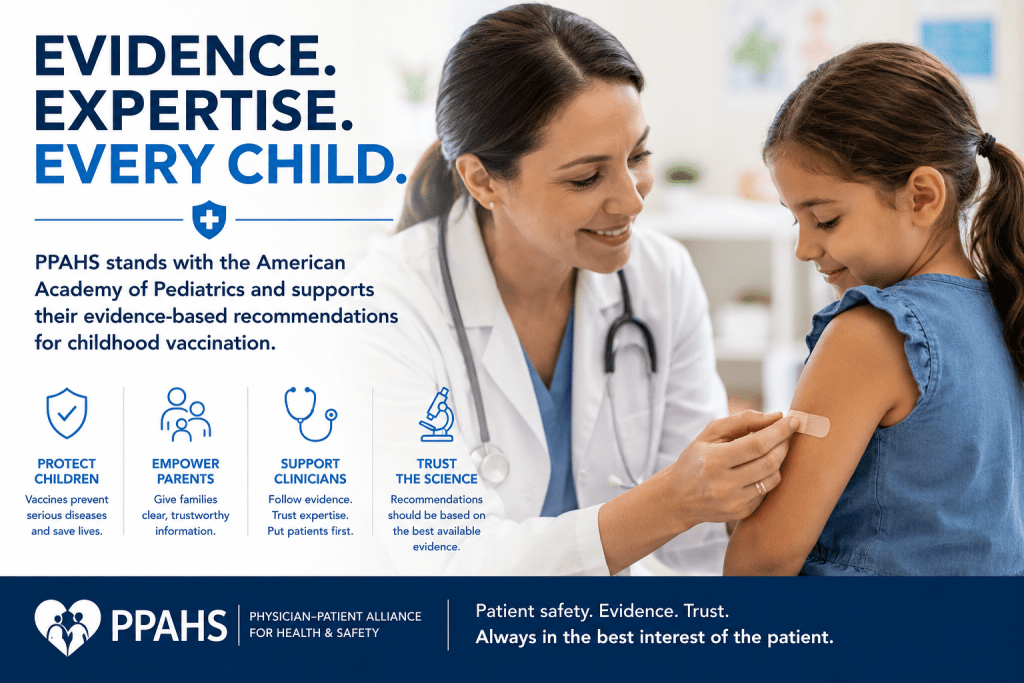
PPAHS supports the American Academy of Pediatrics’ evidence-based recommendations for childhood immunization
Parents should be able to ask their child’s pediatrician a straightforward question—“What vaccines does my child need, and when?”—and receive a clear, evidence-based answer.
That has become more complicated in 2026.
The American Academy of Pediatrics (AAP) has issued its own childhood and adolescent immunization schedule after deciding it could no longer endorse the federal CDC schedule. The AAP’s 2026 schedule recommends routine immunization against 18 diseases, while the federal schedule places some vaccines into high-risk or shared-clinical-decision-making categories.
This divergence creates an important question for clinicians and families:
When respected medical organizations provide different recommendations, how should parents and clinicians determine what is best for a child?
At the Physician-Patient Alliance for Health & Safety (PPAHS), we believe the answer must begin with evidence, transparency, pediatric expertise, and the best interests of the child.
This is more than a debate about vaccines
The current situation is not simply a disagreement between people who support vaccination and people who oppose it.
Both the AAP and the federal government continue to recommend childhood vaccination. The difference is which vaccines should routinely be recommended for all children, which should be targeted to higher-risk populations, and which should involve shared clinical decision-making.
That distinction matters.
For parents, however, conflicting recommendations can be confusing. They may reasonably ask:
- Why does my pediatrician recommend a vaccine that is no longer routinely recommended federally?
- Has new scientific evidence changed?
- What are the risks of receiving the vaccine?
- What are the risks of delaying or declining it?
- Which recommendation is based on the strongest evidence?
These questions deserve clear answers—not political arguments.
Why PPAHS supports the AAP
PPAHS supports the AAP’s 2026 childhood and adolescent immunization recommendations because the Academy states that its recommendations are grounded in a systematic process of evidence review, including vaccine safety data, disease epidemiology, the impact of vaccine-preventable diseases, and the effectiveness of vaccines in preventing disease and complications.
The AAP also has a formal process for developing its immunization recommendations. Its Committee on Infectious Diseases works with external experts, collects conflict-of-interest disclosures, defines the questions to be addressed, and reviews the relevant evidence before recommendations are developed.
The Academy has therefore not simply preserved an old schedule. It continues to review and update its recommendations as evidence changes.
The 2026 AAP schedule recommends protection against 18 serious diseases, including RSV, hepatitis A and B, rotavirus, influenza, meningococcal disease and others.
And the AAP’s position is not isolated. The 2026 schedule received endorsements from 12 medical and healthcare organizations representing more than one million physicians, nurses, pharmacists and other healthcare professionals.
What about the federal recommendations?
The federal government has explained that its revised recommendations were based on a review of U.S. vaccination practices compared with those of other developed nations and an effort to place greater emphasis on individualized risk assessment and shared clinical decision-making.
That approach deserves to be understood and evaluated on its evidence.
But the existence of a federal recommendation does not eliminate the responsibility of clinicians to consider the best available evidence when caring for an individual child.
And importantly, the federal government itself continues to emphasize that vaccines protect children against serious diseases and that vaccination helps protect families and communities.
Conflicting guidance can itself become a patient-safety issue
This is where PPAHS believes the discussion needs to go further.
Consistency and clarity are important components of patient safety.
When parents receive different messages from their pediatrician, professional medical organizations and federal health authorities, confusion can undermine confidence and make informed decision-making more difficult.
That does not mean there can never be legitimate differences in medical recommendations. Science evolves, and recommendations should change when the evidence supports doing so.
But when recommendations differ, clinicians and families deserve to know:
- What evidence led to the recommendation?
- How were the benefits and risks evaluated?
- What has changed in the underlying science?
- What are the potential consequences of delaying or declining vaccination?
Those questions should be answered openly and scientifically.
Put children first
At PPAHS, our approach to patient safety is straightforward: put the patient first, follow the evidence, and communicate clearly.
For childhood immunization, that means supporting recommendations developed through rigorous scientific review and pediatric expertise.
For these reasons, PPAHS supports the American Academy of Pediatrics’ 2026 childhood and adolescent immunization recommendations.
Our position is not intended to diminish the role of federal health authorities or discourage thoughtful discussion about vaccine policy. Rather, it reflects our belief that decisions affecting children’s health should be guided by the best available evidence and the expertise of clinicians who care for children.
Parents deserve clear information. Pediatricians deserve clear, evidence-based guidance. And children deserve the protection that appropriately recommended vaccines can provide.
When guidance conflicts, the answer should not be politics. It should be evidence.
Parents with questions about their child’s immunizations should discuss their child’s individual circumstances with their pediatrician or other qualified healthcare professional.
Please vaccinate – Measles outbreaks are growing in the U.S.: https://www.cbsnews.com/news/measles-outbreak-us-map-2026/
Multiple medical societies react to childhood vaccine executive order – https://www.contemporaryobgyn.net/view/multiple-medical-societies-react-childhood-vaccine-executive-order?ekey=RUtJRDo2M0VFMjlDNy02QTdDLTQ3NEYtQjNFRi01ODc3MzVGNTIwQzU%3D&utm_campaign=emailname&utm_medium=email&_hsenc=p2ANqtz-88Qg_VXKihHEM8BXHPnPR9H960y60zsv4iqsG5bvHzAK28zHaAdhjxYAEpspkUc6l_1kVO_ox5hHDYz_FyMdLBTTwY6g&_hsmi=100243769180&utm_source=hs