Category: Practices & Tips

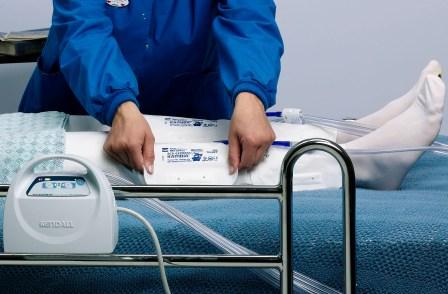
Clinical Tip: How long should mechanical compression devices be worn each day to have the best patient outcome?

Clinical Tip: How long should mechanical compression devices be worn each day to have the best patient outcome?

For more on sequential compression devices – who needs to wear them and how long they should be worn?, please read this article interview with Dr. Amy Campbell on preventing blood clots


Mechanical compression devices should be worn at least 18-20 hours a day to be effective.

By Lynn Razzano RN, MSN, ONCC

Graduated compression stockings and other mechanical compression devices have been shown not to be effective unless they are worn at least 18- 20 hours a day.

Mechanical compression devices exert their therapeutic effects by limiting venous stasis and enhancing fibrinolysis. Continue reading “Clinical Tip: How long should mechanical compression devices be worn each day to have the best patient outcome?” →

Clinical Tip: Alarm Fatigue the Newest Clinical Hazard

By Lynn Razzano RN, MSN, ONCC (Clinical Nurse Consultant)

Increasingly we are seeing publications, alerts and evidence of the clinical phenomena entitled: “Alarm Fatigue”. What is the scope of this latest hazard and what are the new implications for clinical practice change. Continue reading “Clinical Tip: Alarm Fatigue the Newest Clinical Hazard” →

Clinical Tip: Talking is not the same as Communicating

by Michèle Curtis, CeeShell Consulting, lead editor of “Glass’ Office Gynecology”

As the world becomes more global and more technological, opportunities for communication errors only increases.  Communication errors are one of the fundamental precursors for safety and quality errors in healthcare.  Supporting this is data showing that a shared language between health care provider and patient results in better outcomes and quality as well as improved hospital costs and patient satisfaction.  In the healthcare setting, we rely on the words as well as the physical cues and signals patients give us when they are telling us their story.  But if the provider and the patient don’t speak the same language, the risk for misunderstandings and errors increases dramatically, especially if they try to ‘muddle through’ or if information is obtained through a family member or friend who is helping to translate. Continue reading “Clinical Tip: Talking is not the same as Communicating” →

Clinical tip: Completely preventable problems cost an average-sized hospital millions per year

By Lynn Razzano RN, MSN, ONCC (Clinical Nurse Consultant)

That’s the bottom line of a report from the Healthcare Management Council (HMC). HMC analyzed federal data to identify the most common hospital-acquired conditions (HACs) as well as their annual cost per patient and the annual average cost to hospitals. Continue reading “Clinical tip: Completely preventable problems cost an average-sized hospital millions per year” →

5 Tips on How to Improve Patient Safety With the Help of Technology

by Michael Wong

(This article first appeared in Becker’s Clinical Quality & Infection Control.)

More than 10 years ago, the Institute of Medicine in its landmark report, “To Err is Human” pointed out that at least 44,000 people, and perhaps as many as 98,000 people, die in hospitals each year as a result of medical errors that could have been prevented. IOM therefore called for the building of a safer healthcare delivery system.

In 2009, ten years after the original IOM report, Consumers Union, the non-profit publisher of Consumer Reports, concluded in its report “To Err is Human – To Delay is Deadly”:

“Despite a decade of work, we have no reliable evidence that we are better off today. More than 100,000 patients still needlessly die every year in U.S hospitals and health-care settings …”

Implementing change to decrease adverse events and to increase patient safety can be difficult for hospitals and healthcare facilities to implement. But, improvements are possible. Here are five tips to get you started. Continue reading “5 Tips on How to Improve Patient Safety With the Help of Technology” →